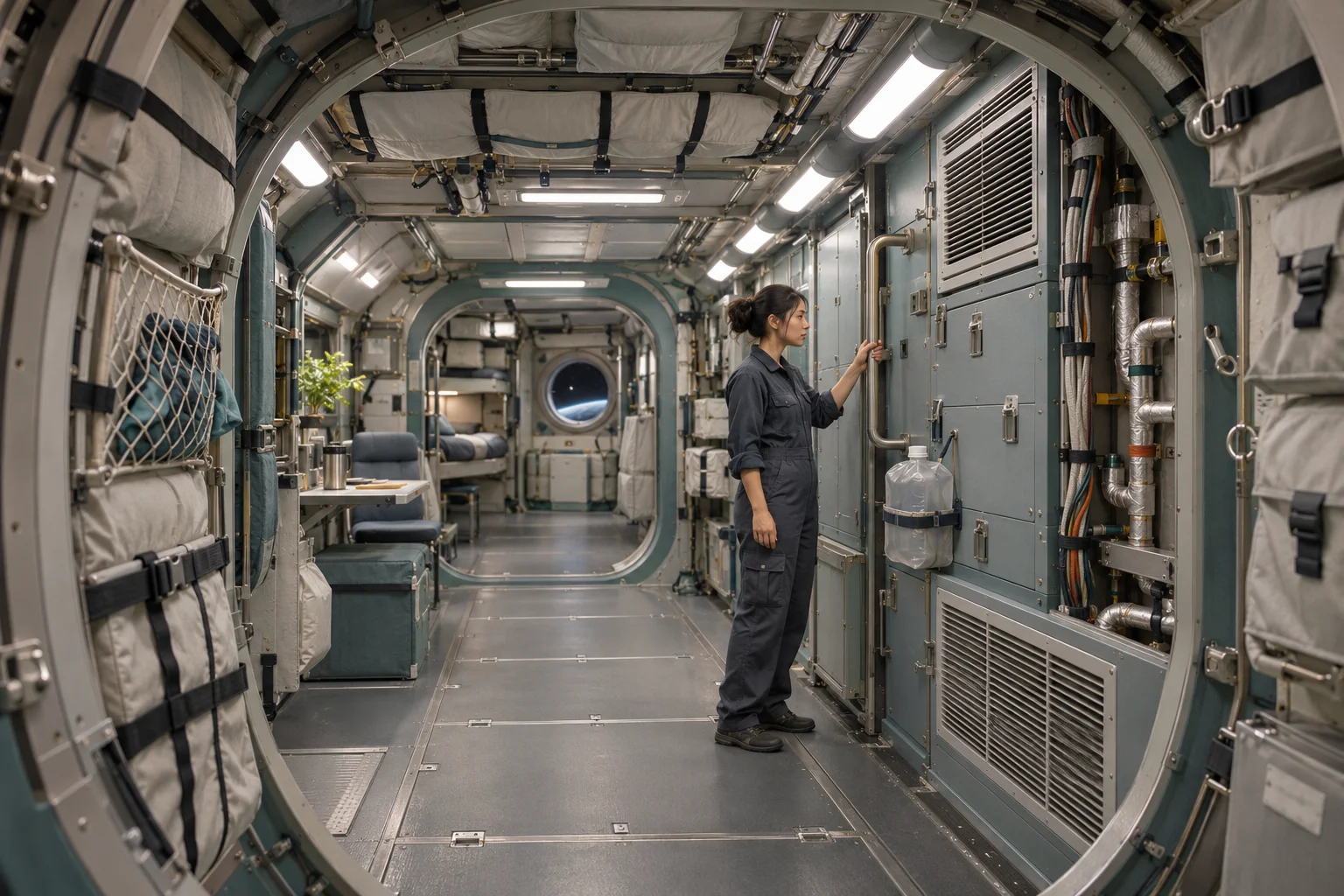
Morning watch
Follow a breath through the ship
Anorak’s crew wakes up in a pressurized compartment. As a crew member exhales, cabin fans draw air toward a return grille. The ventilation system carries exhaled carbon dioxide (CO₂) to the scrubbers and returns conditioned air to the bunk.
- Cabin return
- Filters and CO₂ scrubbers
- Cooling and moisture removal
- Supply back to cabin
Local instruments track total pressure, oxygen partial pressure (the pressure contributed by oxygen), CO₂, temperature and humidity. A normal pressure reading can coexist with rising CO₂ near a bunk with poor airflow. The crew therefore needs readings from occupied zones, including the laboratory and medical spaces with their own ventilation arrangements.
Trace the ducts in Anorak’s 3D cutawayBreakfast
Connect water recovery to oxygen
At the galley, a crew member fills a pouch from Loop D, the protected drinking-water network. Some of that water began as moisture in the cabin air. A cooling coil condenses it and sends it to the treatment system, along with eligible wastewater. Treated water must pass quality checks before it enters the crew’s drinking-water supply. Loop E serves hygiene and cultivation where fitted.
A separate, conditioned feed of verified water can supply an electrolyser. The unit uses electricity to split water into oxygen and hydrogen. A controlled feed adds oxygen to the cabin air. A separate system handles the hydrogen. Stored oxygen backs up generation, while a separate buffer-gas reserve supports pressure recovery after a leak is isolated.
The crew also draws on stored food and hygiene supplies. Water recovery reclaims eligible liquids, while solid waste needs separate handling. A botanical section can use some captured CO₂ where fitted. The baseline still relies on mechanical scrubbing and a verified oxygen supply.
Exercise
Carry heat out of the cabin
During exercise, the crew uses more oxygen and releases more CO₂, moisture and heat. The air handler has to keep up with all four changes. As it cools and dries the returning air, it sends the condensed water to treatment and passes heat across a sealed exchanger to SERAT. Cabin air and coolant stay in separate paths.
A closed coolant loop carries that heat to external radiators. Zorak’s reference design gives life support two independent cooling trains, each sized for the assumed essential crew load. Each vessel needs its own heat budget, radiator capacity and backup endurance.
See Zorak’s crew cooling chambers and radiator deploymentThe Qi concept puts essential ventilation, CO₂ removal and local instruments on protected electrical feeds. Oxygen production runs when power and feed water are available. Even with a working electrical feed, the crew needs a functioning thermal path to keep a compartment habitable.
Fault exercise
When the laboratory cannot share air
In this scenario, Anorak detects unsafe air in a research zone. Follow how the crew’s options change as services become unavailable.
Local air fault
Local protection isolates the lab’s supply and return. The intact zones keep their own circulation. NEXUS compares readings across compartments, and AXIOM retains final physical authority. Before reconnecting the lab, the crew needs evidence that the fault has cleared and that air quality and pressure are stable.
Main power lost
In this example, the essential supply keeps refuge ventilation, CO₂ removal and local instruments running. Stored oxygen can cover oxygen demand while generation is unavailable. The refuge also needs a heat-removal path for its occupants and equipment.
Main and emergency power lost
The manual access design gives the crew a route to a designated refuge. In the blackout example, they use the marked alternate path while the pressure hatch stays secured. Survival time depends on the refuge’s available air circulation, gas supplies, CO₂ removal, water, monitoring and thermal control, and on how many people are inside.
Follow the blackout refuge routeWhy can CO₂ still build up with stored oxygen available?
Stored oxygen replaces the oxygen people consume. The crew keeps exhaling CO₂. Air has to move from the breathing zone to a working CO₂ removal system, whose capacity must cover the number of occupants and the duration of the outage.
Shift handover
Size the system for the people aboard
The same services appear across the Qi Vanguard Fleet, with different occupancy and isolation cases.
- Flagship and research vessels
- Plan for occupied zones with separate ventilation, including crew quarters, research spaces and medical isolation where fitted.
- Carriers and Norak
- Count crew arriving from docked craft aboard a carrier. On Norak, include passengers in air, water and refuge planning.
- Interceptors and shuttles
- Provide onboard cabin protection for independent sorties. Verify each life-support handover to a compatible host where fitted.
Food, hygiene supplies, spare filters and other consumables also belong in the mission inventory. The ZENIT Safety Authority (ZSA) owns qualification. Airflow, gas inventory, thermal capacity and refuge endurance are open until verified for each vessel and crew load.
See the Qi vessel classes and water circuits