Routine check
A flagged reading prompts a medic to review the entry and decide whether to repeat it or follow up. Crew members can report symptoms any time, even if the record shows no alert.
Power, fields, supervision and physical authority
NEXUS compares telemetry with the system model. The CMC provides a timing and magnetic reference. GENI uses that reference and SERAT’s power and cooling limits to coordinate field requests. AXIOM can veto a request, and local protection can trip the equipment independently.
On Earth, Living Systems Intelligence (LSI) gives operators a shared view of facility conditions and the status of essential services.
Aboard Zorak, PATRIOT helps the care team carry health observations and follow-up plans between shifts.
Try Zorak’s startup replay ↓Follow one Outverse coil branch from protected power to measured response. Compare a fresh CMC reference with a packet captured before the bus reset.
Simulation

The replay starts with conditioned source power and follows a branch that is initially de-energized. Coil feedback describes the branch response. Protective effect requires its own measurement.
Explore Zorak’s full power and propulsion cyclePower and cooling
SERAT coordinates power distribution and cooling across ZENIT’s Earth and Space systems. It checks whether available supplies and reserves can support essential loads before it admits optional demand.
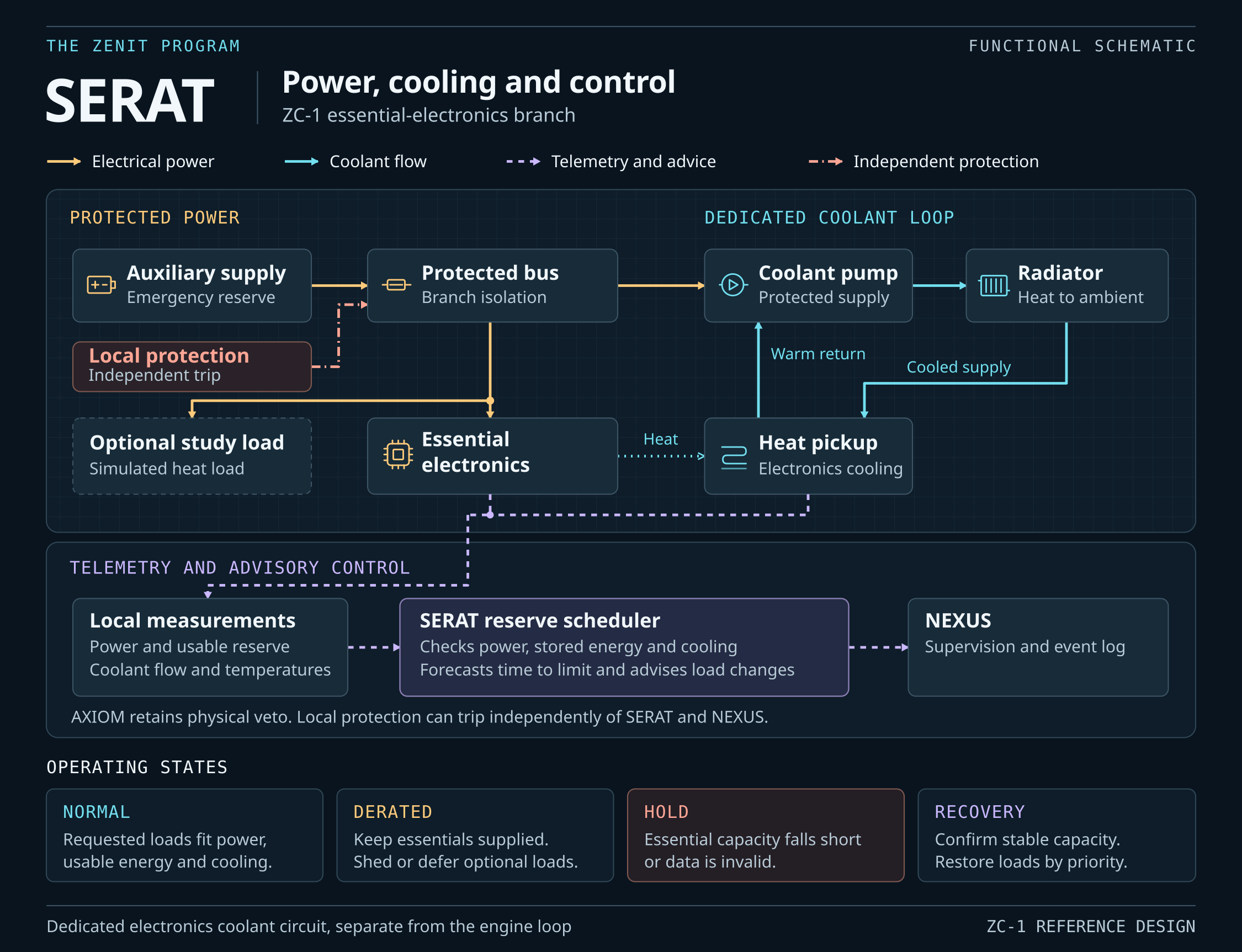
In this ZC-1 reference design, a protected bus supplies the essential electronics and coolant pump. SERAT uses power, reserve and coolant readings to advise which loads can run. Local protection can trip the branch independently.
Open full-size schematicThe replay follows a 12 W essential circuit and an 18 W optional circuit during an 8-second interruption.
Simulated run
Input present or circuit powered Off or unavailable
The reserve supplies the essential circuit until the primary input qualifies again. The optional circuit waits for that qualification.
| Time interval | Primary input | Reserve output | Essential load | Optional load |
|---|---|---|---|---|
| 0–4 s | Present | 0 W | 12 W | 18 W |
| 4–12 s | Lost | 12 W | 12 W | 0 W |
| 12–14 s | Present | 12 W | 12 W | 0 W |
| 14–20 s | Present | 0 W | 12 W | 18 W |
The model records an essential-capacity shortfall while the primary source is unavailable or awaiting qualification. Both circuits resume when the primary input qualifies.
| Time interval | Primary input | Reserve output | Essential load | Optional load |
|---|---|---|---|---|
| 0–4 s | Present | 0 W | 12 W | 18 W |
| 4–12 s | Lost | 0 W | 0 W | 0 W |
| 12–14 s | Present | 0 W | 0 W | 0 W |
| 14–20 s | Present | 0 W | 12 W | 18 W |
The model uses a 36 W primary limit, up to 15 W of reserve power, and a 2-second stable-input check before returning to the primary source. It assumes adequate cooling, valid readings and instantaneous switches. A physical run will establish the actual voltage dip and switching time.
Use an isolated low-voltage fixture with dummy loads, current limits and independent shutdown. Set the essential circuit’s minimum acceptable voltage from its equipment specification before the run. Record the fixture setup, reserve conditions and sample rate on the same run record.
| Measurement | What to record | Proposed acceptance |
|---|---|---|
| Essential continuity | Minimum load voltage and longest interval below the selected floor. | With a healthy reserve, the measured voltage stays within the essential load’s acceptance limits through transfer and restoration. |
| Optional recovery | Elapsed time from primary input return to actual optional-load current. | Current returns after the primary input qualifies. Record the full observed delay. |
| Reserve delivery | Voltage and current at the reserve output and essential load, with time stamps. | Delivered power and energy remain within the fixture’s approved limits. |
SERAT’s requested actions, local protection responses and measured load behaviour belong in the same test record. AXIOM retains the physical veto, and the ZENIT Safety Authority reviews the test evidence. IEC 61000-4-29 provides a reference for repeatable DC input interruption tests. IEC test method
Field coordination
GENI coordinates proposed field settings using sensor readings, the CMC magnetic reference and SERAT’s power and cooling limits. Space Outverse uses five layers across five hull sectors for 25 logical regions. Earth fusion uses a separate five-layer GENI Inverse concept.

The current GENI framework applies Equilibrium First within AXIOM’s operating limits. Compare corrective energy over the same interval and keep essential services inside their approved limits.
In the FCMC-1 simulation, Centri holds the formation when Anorak exceeds its local limit, even as the fleet average improves. Readiness requires current local observations, AXIOM clearance, and SERAT power and cooling margin on each vessel.
See how the offline allocator changes its request when a cooling limit or a stale reading affects the fore sector.
Simulation
| Layer | Fore | Stbd | Aft | Port | D/V |
|---|---|---|---|---|---|
| L5 | – | – | – | – | – |
| L4 | – | – | – | – | – |
| L3 | – | – | – | – | – |
| L2 | – | – | – | – | – |
| L1 | – | – | – | – | – |
Values are simulated effort units. A value of 1 is the baseline. An asterisk marks a stale observation. The table tracks requests. Coil response and protection each require their own measurements.
Run the three cases on an isolated controller with simulated sensors and a dummy output. Record the region requests, available capacity and output feedback on the same time base. Check that requests stay within the fixture’s limits, shortfalls are recorded and stale observations are flagged. The ZENIT Safety Authority reviews the test evidence.
Central Magnetic Core
The CMC gives Zorak’s field systems a shared magnetic and timing reference. It sits near the vessel’s centre of mass and operates alongside the separate fusion power chain.
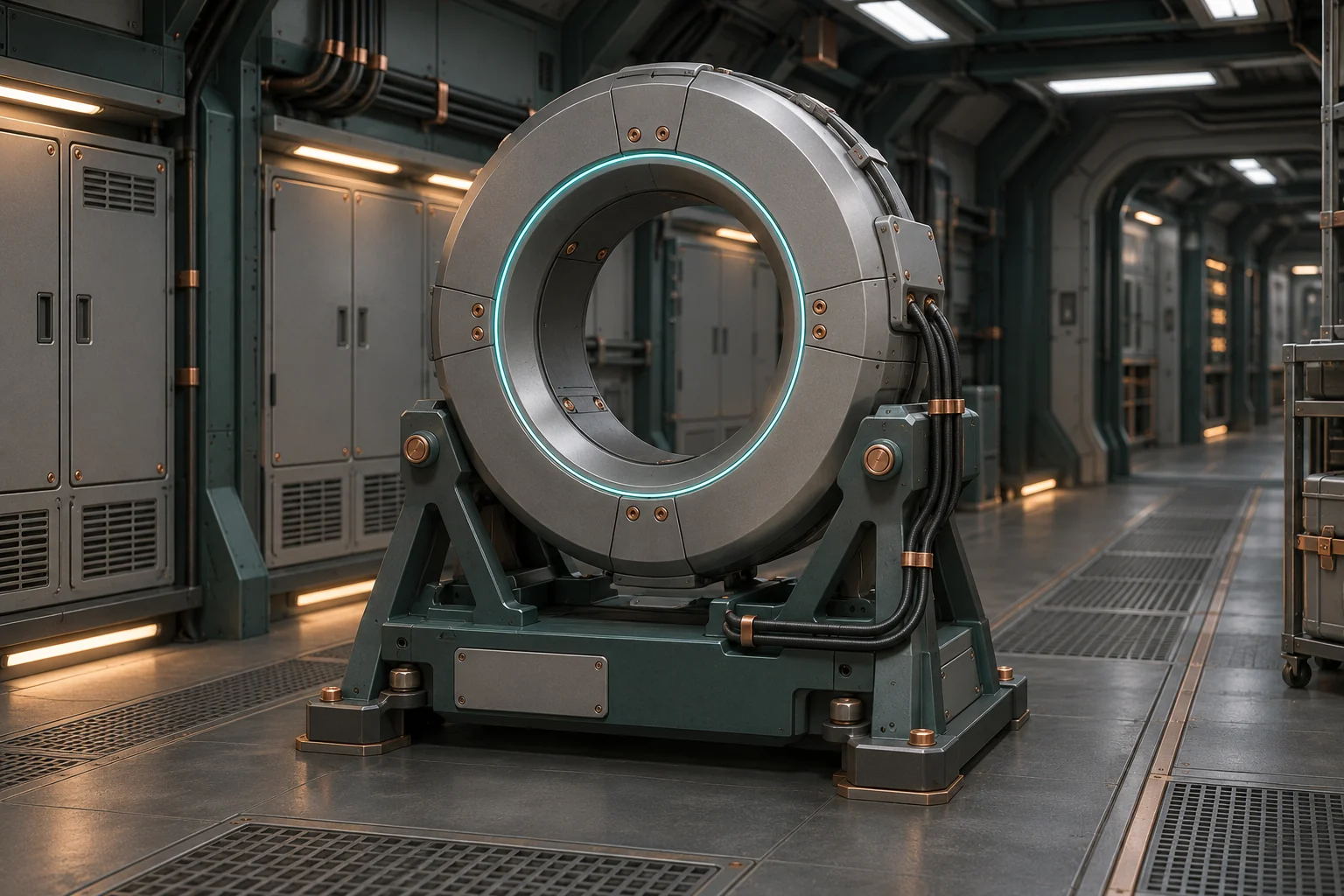
The replay illustrates the logic for one initially de-energized branch. Reference quality, permission and measured response are separate records. The protective effect of a field would require a separate physical test.
Physical authority
AXIOM retains the final physical veto over requested operations. A local interlock can trip its own equipment independently. NEXUS supervises and records events, while the ZENIT Safety Authority authorizes tests and reviews their evidence.
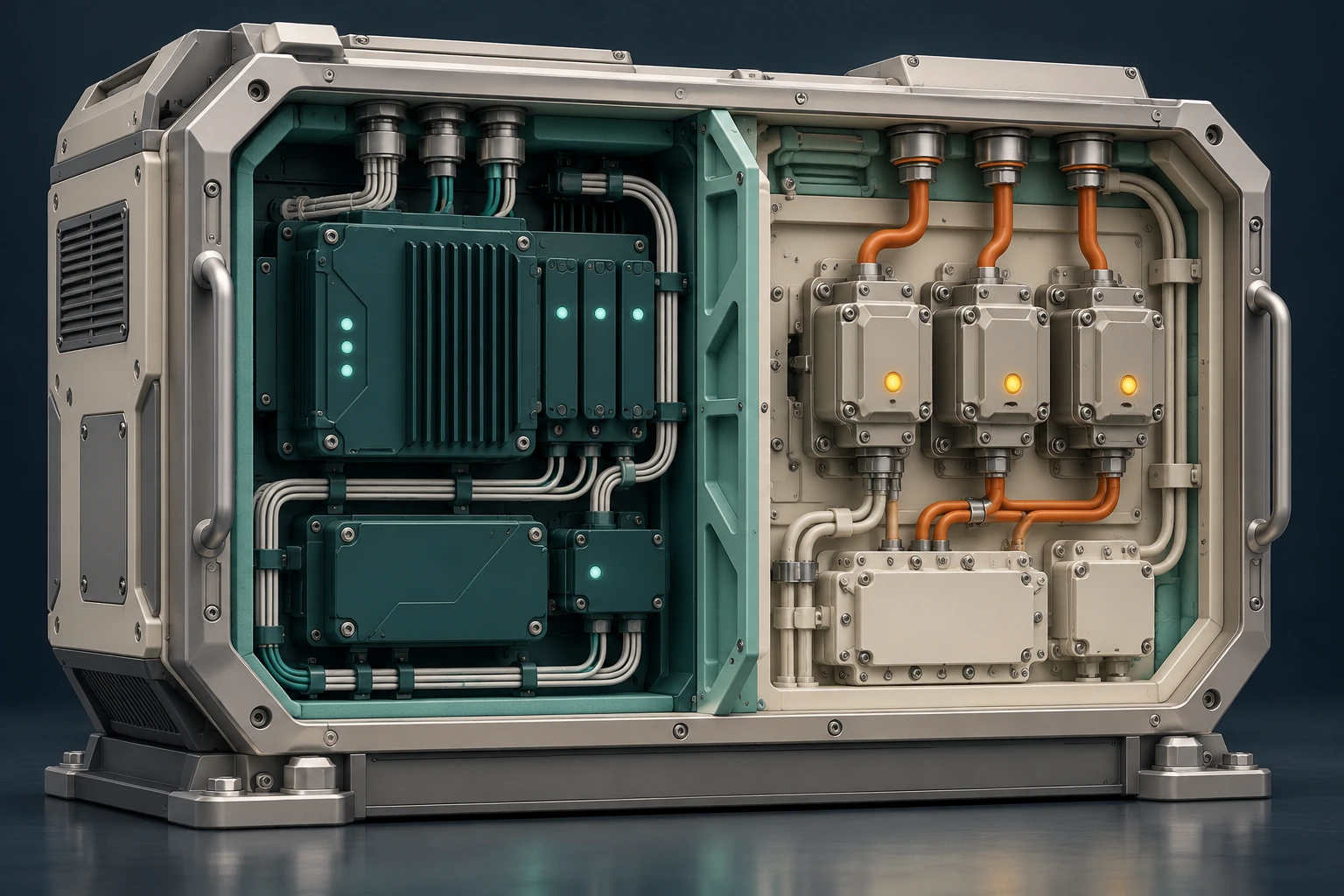
Controlled output. The branch enables when permission and local checks agree. An independent trip takes it to its approved protective state. Output feedback records the result.
Follow the enable request, the local interlock and the measured state of a simulated dummy load.
Simulation
A valid request passes the AXIOM gate. With the local interlock healthy, simulated feedback confirms that the dummy load energizes.
AXIOM blocks a new enable request. Simulated feedback confirms that the dummy load stays de-energized.
A local fault trips the test branch after enable. The independent trip stays latched in this fixture until a deliberate reset after the fault clears.
The replay follows a single isolated test branch. On a vessel, the approved protective action depends on the operating phase and the essential services that need to remain available.
Use an approved low-voltage fixture with a dummy load and observe both the request and switched output. Apply a veto before enable and a local trip after enable. Repeat the local-trip case with the supervisory link disconnected. Record the order of events, the measured output and whether the branch stays tripped until reset.
Supervisory digital twin
NEXUS compares verified telemetry with the expected behaviour of ZENIT equipment. It flags trends and gaps in the evidence, advises operators and records decisions. AXIOM retains physical veto authority, and local interlocks can trip equipment independently.
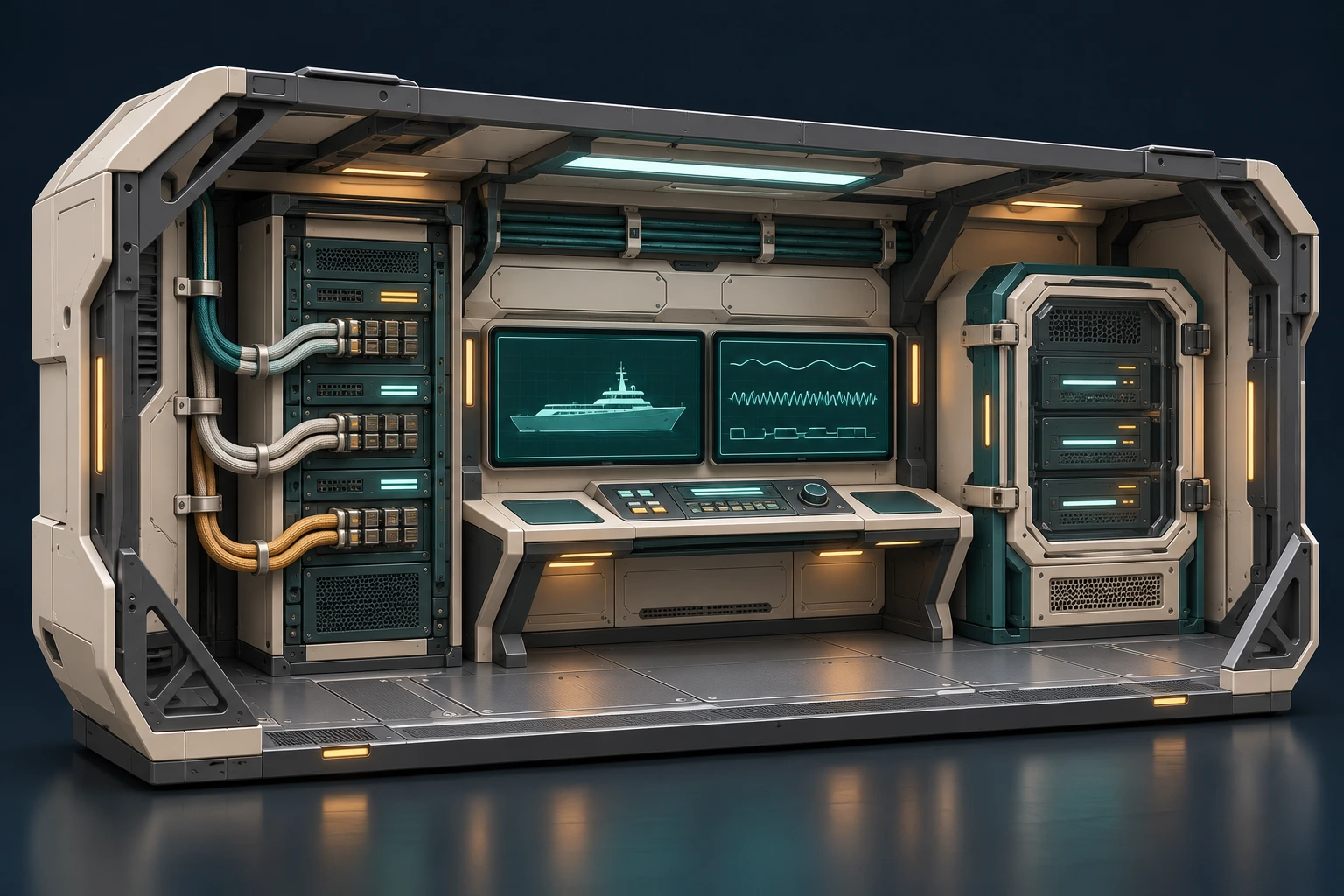
Compare what the vessel and fleet can see when a report expires or the reporting link drops.
Inspect the shared quantity and event checks: energy closure, unique credits, evidence maturity, force density and separate crossing/receipt records.
Simulation
A fresh, verified coolant-flow reading reaches onboard NEXUS. It compares the sample with the expected range and records the original measurement time.
The reading passes its maximum useful age. NEXUS flags the channel as unassessed, preserves the old sample in the event history and asks for a fresh sample.
The fleet reporting link drops while the onboard instruments keep sending fresh readings. NEXUS and the recorder continue locally. The fleet view marks the vessel disconnected and shows the age of the last report.
The example assumes powered onboard instruments, a separate local protection path and a fleet report that includes this channel. After reconnection, new reports qualify on their own evidence and delayed events retain their original measurement times.
Use a simulated instrument and record its readings on the onboard and fleet displays. Send an expired sample, disconnect the fleet report path and restore it with a fresh sample. Check that the displays distinguish current, stale and disconnected states, and that local protection remains available throughout. Compare the event log with the instrument’s time stamps.
Navigation and docking
AGCM checks route geometry and the history of the vessel’s position reports before a close approach. During space docking, it compares where the shuttle and host report being, how their docking interfaces line up, and how reliable those observations are.

Compare three sets of navigation reports for the same shuttle and host.
Simulation
Independent observations agree within the study’s limits. Alignment supports an approach request, which still needs separate permission and local checks.
The host’s report has expired. The last known position stays in the log and the crew waits for a current report before reassessing alignment.
Two current readings disagree beyond their reported uncertainty. AGCM flags the conflict. The approach stays on hold while the crew checks which reference applies.
This conceptual exercise covers approach evidence. Capture, load transfer and clearance for crew transfer each require their own confirmation.
Crew health and medical handover
A crew member’s health history should be available to the medic taking over their care. PATRIOT is ZENIT’s proposed onboard record for observations, readings and follow-up in Zorak Sick Bay.

The medical team interprets the information and decides what care is needed.
A flagged reading prompts a medic to review the entry and decide whether to repeat it or follow up. Crew members can report symptoms any time, even if the record shows no alert.
The receiving medic verifies the patient and confirms receipt of the observations and pending follow-up. Delayed or incomplete entries stay marked so the next team can judge what needs checking.
The local team keeps a manual time-stamped record and reconciles it when service returns. The crew can still reach a medic, and cabin alarms operate through their own systems.
The proposed access rules keep personal readings within the care team. Cabin life support maintains habitable conditions while medics look after the people aboard.
PATRIOT is a concept. Clinical performance, alert workload, access controls and the offline handover need verification. These references describe the spaceflight context for health records and medical support.
LSI is ZENIT Earth’s proposed operational model for facilities and infrastructure. It brings equipment readings, environmental conditions and maintenance records together so operators can see which services are available, what has changed and what still needs to be checked.

The grid and regional data link go down at the Critical Continuity SafeSpot. In this scenario, the SERAT reserve keeps the local monitors and recorder powered. Operators can still see current readings from connected on-site instruments. The regional display marks the site disconnected and shows when it last received a report.
If the water-level reading expires, LSI marks water availability as unassessed and displays the time of the last sample. The operator checks the local indicator and confirms a fresh reading before sharing the status again. AXIOM retains physical veto authority, and local interlocks can still trip equipment independently.

The article describes a ZENIT Earth concept. The outage and illustrations show how it could work.