Physical Cycles
See how the Qi Fleet powers its drives, what it takes to keep a fusion plasma hot while supplying useful power, and how combustion turns a wheel.
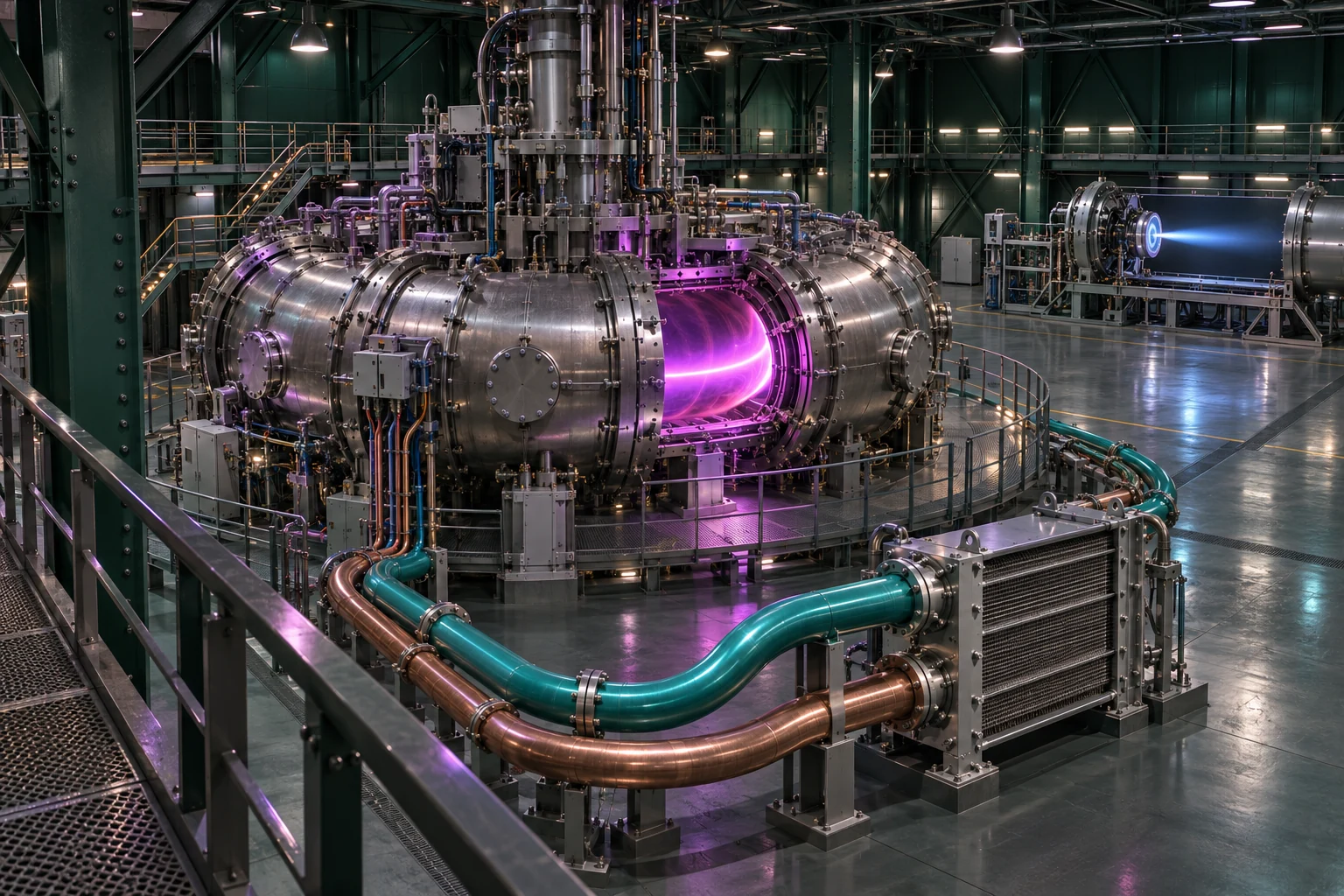
Propulsion and reactor power
How the propulsion in all the Qi - Vessels works
All Qi vessels share a power-to-drive cycle. The vessel’s onboard source supplies electricity, and protected distribution allocates a share to the drives. With conventional exhaust, a drive accelerates carried propellant away from the vessel. The exhaust carries momentum in one direction and the vessel gains momentum in the opposite direction.
- Supply onboard electricity
- Allocate protected drive power
- Use the drive to manoeuvre
- Reject heat and check reserves
What repeats. The cooling system removes drive heat. The vessel can coast with its drives idle. The next powered interval depends on available power, cooling capacity and, for an exhaust drive, the remaining propellant.
Vessel examples. Zorak’s two fusion cores feed its twin stern drives through SERAT. Norak’s study uses a single compact fusion source. The Qi shuttles use Compact Power Core concepts for their own drive layouts.
How fusion can sustain useful power
External heating forms a hot plasma, and magnetic confinement slows the loss of its energy. To hold a steady temperature, external heating and heat returned by fusion products together have to balance losses. In the deuterium–tritium reference case, charged helium nuclei can heat the plasma. Neutrons carry energy outward, where surrounding material can absorb it as heat.
Plasma heating and losses
- Auxiliary heating
- Confined fuel plasma
- Fusion reactions
- Charged products deposit heat
Heat feedback to the confined plasma.
Steady plasma energy
Absorbed auxiliary power + deposited fusion heating = plasma energy losses.
Plant electricity balance
- Neutrons carry energy outward
- Reactor structures transfer heat to coolant
- Conversion train drives the generator
- Gross electrical output
Net electrical output
Gross electrical output − internal electrical loads.
The conversion train also releases heat. Some can serve a matched demand, and the remaining heat needs a sink.
Diagnostics track plasma temperature, density and stability. Fuel replenishment, auxiliary heating and removal of helium and impurities help maintain those conditions. At the Earth facility, coolant would carry heat to the separate SERAT Energy Island. Heating, cooling and other internal electrical loads reduce the electricity available for export.
Run the fusion core modelEarth fusion-to-grid modelITER on plasma and plant balances
Heat and materials
Heat transfer and rejection
Heat conducts through an exchanger wall and transfers between the wall and moving fluids by convection. The Earth facility concept can deliver useful heat to a district network or reject surplus heat to outdoor air. Zorak’s radiator concept releases heat to space as infrared radiation.
- Heat pickup
- Heat transport
- Exchanger or radiator
- Coolant releases heat
Cooled fluid returns to heat pickup through its own circuit.
Follow the balance. The fluid recirculates. Heat goes to the receiving system or environment. At steady temperature, the heat leaving the loop balances the heat entering it.
Worked example
In a teaching example, 1 kg/s of liquid water warms by 5 K. Multiplying flow by specific heat and temperature rise gives about 20.9 kW carried away at steady flow.
Evaporation, condensation and freezing
Liquid water takes in heat as it evaporates. In the Qi cabin concept, a cold surface below the air’s dew point collects vapour as liquid and transfers heat to the cooling loop. The condensate goes to treatment and quality checks before reuse.
- Liquid water
- Water vapour
- Condensate
- Treatment and reuse
Follow the change of state. Water releases heat as it condenses or freezes. Melting and evaporation absorb heat. The ZA-1 study explores using recovered heat to prevent ice formation on wing surfaces.
Thermal expansion and contraction
Most engineering solids expand as they heat up and contract as they cool. Bonded materials can expand by different amounts. If their movement is constrained, the temperature change can create stress in the joint.
- Warm up
- Expand
- Cool down
- Contract
Apply it to Zorak. During a warm-up and cooldown, a radiator panel and its supporting structure may change length by different amounts. Temperature and displacement together reveal the response.
Refrigeration and heat pumping
In a vapour-compression cycle, a refrigerant absorbs heat as it evaporates. A compressor raises its pressure and temperature. It then gives up heat as it condenses. A pressure drop prepares it to absorb heat again.
- Evaporate and absorb heat
- Compress vapour
- Condense and release heat
- Lower pressure
Refrigerant returns at low pressure to the evaporator.
Apply it to Zorak’s crew chiller study. The hot side has to reject the heat removed from the cabin plus the energy supplied to run the chiller.
Fluids and forces
Pressure and circulation
A pump adds energy to a liquid loop. Flow through pipes, valves and exchangers dissipates some of that energy. A restriction can reduce flow even while the pump is running.
- Pump raises pressure
- Liquid moves
- Resistance dissipates energy
- Reach the return line
Liquid returns to the pump inlet.
Observe the ZC-1 coolant loop. Flow, pressure and temperature readings help distinguish reduced circulation from a rising heat load.
Cabin air circulation
Fans move air through crew spaces and back through the treatment equipment. The returning air carries heat, moisture and exhaled carbon dioxide. The circulation pattern helps distribute conditioned air and carry contaminants toward removal equipment.
- Supply duct
- Crew space
- Return grille
- Filter and condition
Conditioned air returns to the supply duct.
Track two changes. Airflow indicates how well air moves. Oxygen and carbon dioxide readings indicate its composition. Separate equipment replaces consumed oxygen and removes carbon dioxide.
Qi Fleet 3D cabin air modelCO₂ capture and scrubber regeneration
Buoyancy and floating draft
A floating hull displaces water. The upward buoyant force equals the weight of that displaced water. If the crew adds a load, the vessel settles deeper until buoyancy balances the new total weight.
- Add a load
- Draft increases
- Displace more water
- Reach a new balance
Apply it to ZCS-1. Draft shows how deep the hull sits. How the load is distributed also affects the vessel’s tilt and trim.
Aerodynamic lift and drag
Air flowing around the ZA-1 concept’s wing creates a pressure distribution. The resulting aerodynamic force has a lift component perpendicular to the oncoming airflow and a drag component that opposes motion through the air.
- Air passes the wing
- Pressure and flow change
- Lift and drag act
- Aircraft responds
Observe the flight state. Air density, speed and wing angle affect the forces. In steady, straight, level flight, lift balances weight and thrust balances drag.
Motion and loads
Momentum transfer and thrust
Jets and propellers produce a reaction force by pushing fluid rearward. The ZA-P01 propeller moves air, and a marine propeller moves water. A Qi vessel using conventional exhaust in space carries the mass it expels.
- Supply energy
- Accelerate fluid
- Fluid gains momentum
- Vehicle feels thrust
Follow the momentum. The reaction force on the drive points opposite to the change in the flow’s momentum. Vehicle acceleration also depends on the other forces acting and the vehicle’s mass.
Traction and regenerative braking
A battery-electric roadster draws energy from its pack to drive the wheels. During regenerative braking, the wheels drive the motor as a generator. Some of the vehicle’s kinetic energy returns to the pack. Drag, rolling resistance and conversion losses reduce the amount recovered.
- Battery output
- Wheel motion
- Motor generates
- Partial energy return
Watch the energy return. The pack’s ability to accept charge can limit recovery. Mechanical braking dissipates energy as heat.
Worked example
A generic 1,000 kg vehicle at 10 m/s has 50 kJ of translational kinetic energy, using ½mv². That is about 0.014 kWh before losses. The example uses illustrative values.
Repeated loads and fatigue
Each landing loads and unloads a vehicle’s supporting structure. In the Norak study, touchdown and weight transfer are distinct phases. At sea, repeated waves bend a ship’s hull through a different load history. Changes in stress can accumulate fatigue damage over many cycles.
- Apply load
- Structure deflects
- Unload and recover
- Repeat with accumulated history
Track the load history. Elastic deflection can disappear when a load is removed. Fatigue damage can persist. The range, frequency and number of load changes all help describe the history.
Vibration, resonance and damping
Rotating machinery can apply a repeated force. A structure can respond strongly when the forcing frequency approaches one of its natural frequencies. Damping dissipates vibrational energy and limits the response.
- Repeated force
- Structure oscillates
- Damping dissipates energy
- Oscillations decay when forcing stops
Apply it to a propulsion mount. In the ZCS-1 concept, comparing vibration frequency and amplitude with shaft speed would show which changes track the drive.
Physics and engineering references
Some of the diagrams trace cycles whose stages repeat, such as the piston stroke sequence or a coolant loop. Others trace a one-way transfer or a response to a change in load. ZENIT applications are concept studies. The worked numbers are teaching examples.
- OpenStax · Heat engines · Refrigeration · U.S. DOE · Hydrogen combustion and NOₓ
- NASA Glenn · Gas turbine thrust · Lift and drag
- U.S. DOE · Burning plasma · ITER · Fusion heat and electricity
- NASA, Reference Guide to the International Space Station, Assembly Complete Edition (November 2010), p. 92.
- NASA · Cabin air and water recovery
- OpenStax · Heat capacity · Phase change · Fluid flow
- OpenStax · Thermal expansion · Buoyancy · Forced oscillations
- U.S. Department of Energy · Electric vehicles and regeneration
- NACA · Repeated loads and fatigue
Combustion turns fuel energy into work
Hydrogen reacts with oxygen to form water vapour and release energy. In the ZC-1 concept, the hot gas raises cylinder pressure and expands against the piston. The crankshaft turns that motion into torque, and the drivetrain sends it to the wheels. Heat also leaves through the exhaust and cooling circuit.
- Intake
- Compression
- Combustion and expansion
- Exhaust
Ground · ZC-1
Expansion pushes the piston. At the tyre contact patch, the road supplies the forward force that moves the car.
Air · ZA-1 and ZA-P01
The ZA-1 jet concept accelerates propulsive airflow rearward. The ZA-P01 turbine drives a gearbox and propeller, which accelerates outside air.
What leaves the cycle. A piston repeats its motion with fresh intake. Exhaust gases carry mass and heat away. High-temperature hydrogen combustion in air can also produce nitrogen oxides (NOₓ).
Illustrated propulsion pathsHydrogen combustion chemistryHydrogen chain reactionZorak’s electric-exhaust study