
Earth
Earth Fusion Facility
One stellarator-derived reactor supplies controlled energy to the separate SERAT Energy Island.
ZENIT Earth & Space
Confined fuel plasma is at the center of ZENIT’s reactor designs on Earth, at CORAC on the Moon, and aboard the Qi Vanguard Fleet.
Earth plant · Stellarator geometry
Vacuum, magnetic confinement, primary cooling and local protection must be ready before the model admits or heats fuel.
Model scope. The sequence demonstrates startup, energy routing and the response to a cooling fault. Measuring plasma performance, heat removal and net power requires physical reactor tests.
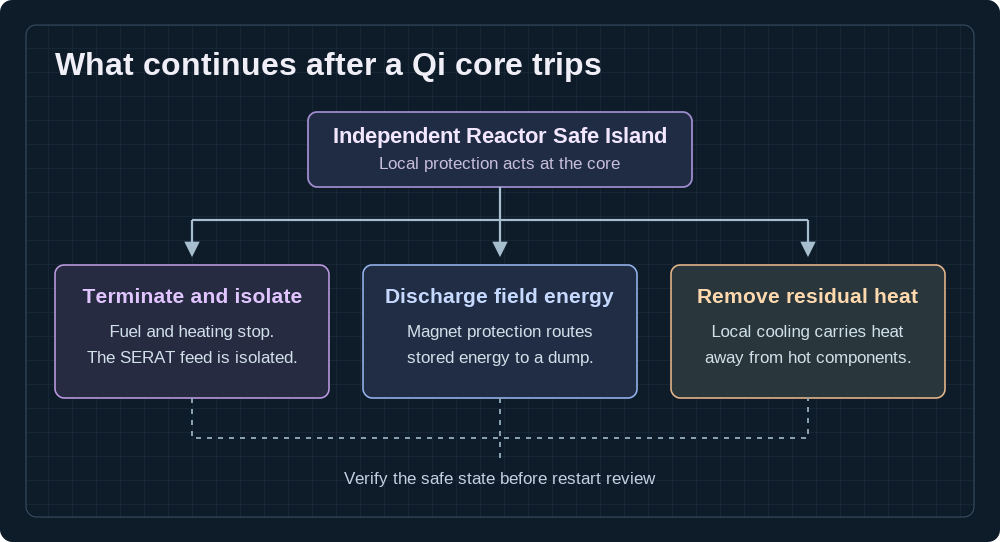
In the Qi design, each core has its own Independent Reactor Safe Island (IRSI). It stops fuel and heating and isolates the core’s SERAT feed. The magnet circuits still hold energy and the components remain hot, so two local paths continue working after the trip.
Magnet protection routes stored field energy to a discharge path. Independent cooling carries residual heat away from the reactor components. These functions are designed to act locally during loss of NEXUS or the other reactor. A new start repeats the readiness and protection checks. Physical qualification remains open.
Earth
One stellarator-derived reactor supplies controlled energy to the separate SERAT Energy Island.

Moon
The lunar outpost’s proposed plant has its own fuel and exhaust cell, heat exchanger and surface radiators.
Qi Vanguard Fleet
Fusion A and Fusion B each have a separate plasma vessel, local protection and a protected SERAT feed.