Norak surface mission
Follow a single Qi survey sortie from orbital staging through landing, roadster and drone deployment, and recovery aboard Norak.
Approach and transfer / Normal operation / Fault response / Recovery Illustrated walkthrough
Starting conditions
The main fleet stages in space. Norak carries the R3 survey loadout with a Scout, a fuel-cell Cargo roadster, four planetary survey drones and two orbital relays. This walkthrough uses a compatible surveyed base and assumes a separately accepted route for each flight phase.
Operating sequence
Stage in orbit
Assign the working relay and backup. Record whether any orbital relay is deployed, so the landing case reflects the load Norak actually carries.
Approach and secure the base
Compare the loaded case with the updated guide and deck. Check measured support and a stable handover before opening the isolated cargo compartments.
Release the surface equipment
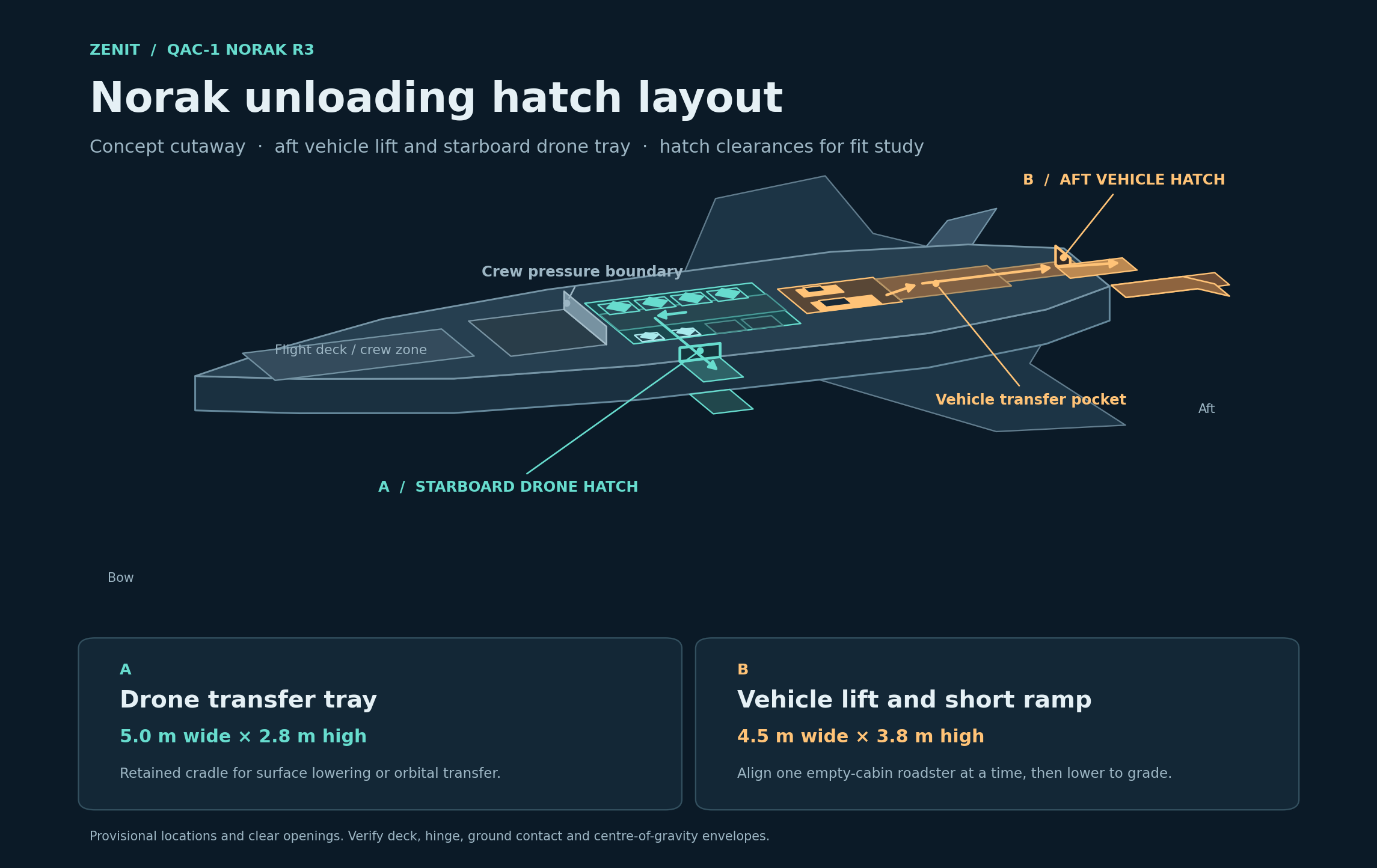
Use the separate drone tray and roadster lift. Check whether the survey drone can operate in the local conditions and whether the roadster has the route, energy and cabin support needed for the return.
Survey with a return margin
Track usable energy, thermal margin and communications during the sortie. Reassess when the assignment changes and preserve the capability to return to Norak.
Recover, secure and update the manifest
Recover or account for each deployed drone. Inspect the roadster and secure it unoccupied in its assigned berth. Reconcile battery or fuel-cell servicing and the stowed load before closing the bays.
Prepare the next transfer
Review cabin services, verified bay closure, reserves and the updated manifest. Treat ascent and any orbital relay recovery as separate phases with their own clearance.
Hold and recovery
Keep the next phase on hold when landing support, a return margin or the recovered load cannot be verified. Maintain the local support available to the crew and document which evidence is missing.
Model and references
Play the loaded R3 landing replayThis is a conceptual walkthrough. Support capacity, surface conditions and atmospheric entry and ascent remain separate verification work.
ZENIT concept procedure. Models and replays use illustrative conditions.