Outverse Shield response and recovery
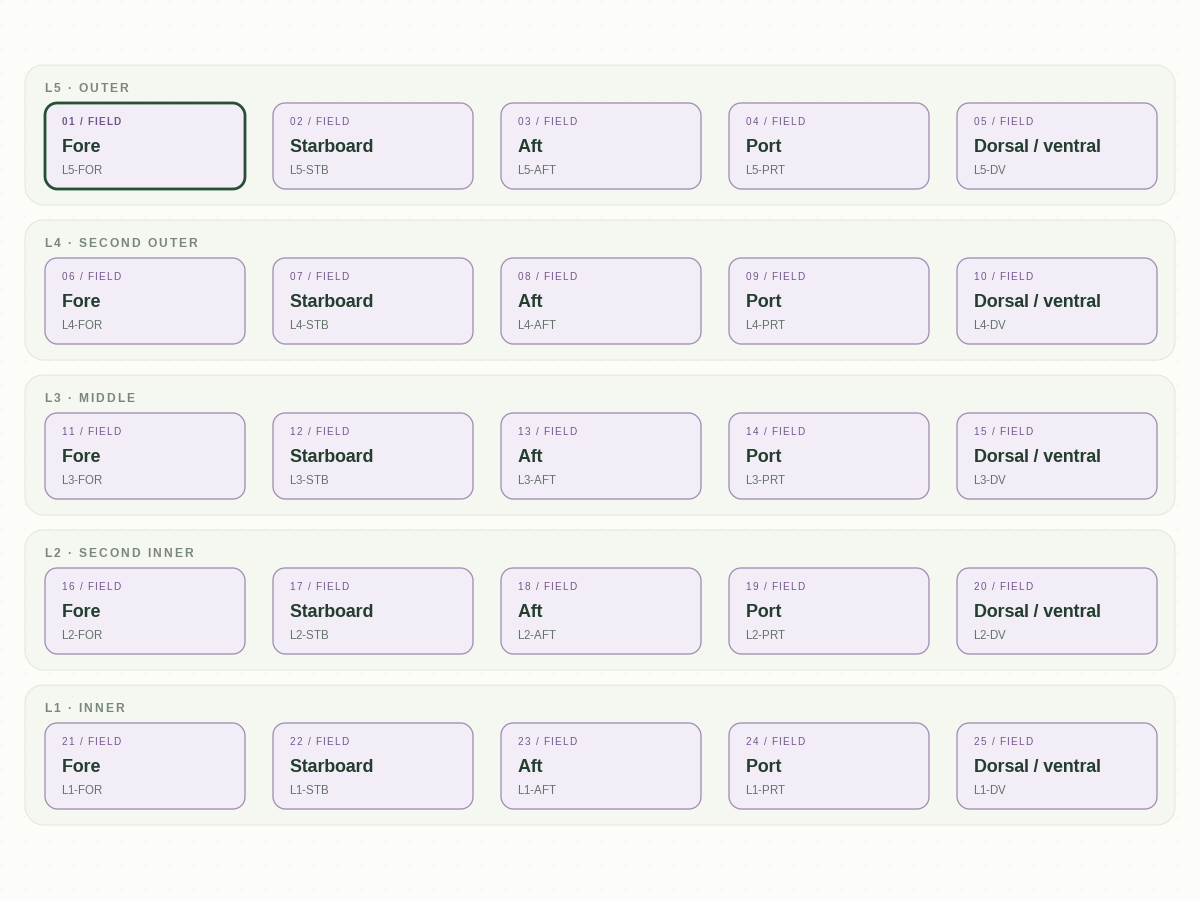
GENI coordinates the space shield’s five layers across five hull sectors, giving 25 controlled regions.
Fault response / Recovery Interactive replay
Starting conditions
The space shield study has a current reference and available power and cooling. It uses five layers across five sectors.
Operating sequence
Sense the event
Hull and field sensors report changes. NEXUS maps the reading and its location and marks missing readings as unassessed.
Locate the affected regions
Use the layer and sector map to identify the relevant addresses. The five layers run from L5 outside to L1 inside.
Check reference and reserve
GENI checks the accepted CMC reference and SERAT’s available power, reserve and cooling before coordinating a request.
Drive permitted coils
Local drivers regulate the distributed coils for the permitted field settings. AXIOM can veto the response.
Measure and inspect
Compare requested and measured field behaviour and monitor hull condition. Physical inspection can confirm a suspected impact or damage.
Recover the reserve
Use the qualified coil-energy recovery or discharge path. Account for remaining heat, recharge and residual exposure before the next request.
Hold and recovery
Keep the request, measured coil response and protection result separate. Inspect the affected region before returning it to normal assignment.
Model and references
Open the interactive cycleThe region map describes control geometry. Physical protection ratings require measured qualification.
ZENIT concept procedure. Models and replays use illustrative conditions.