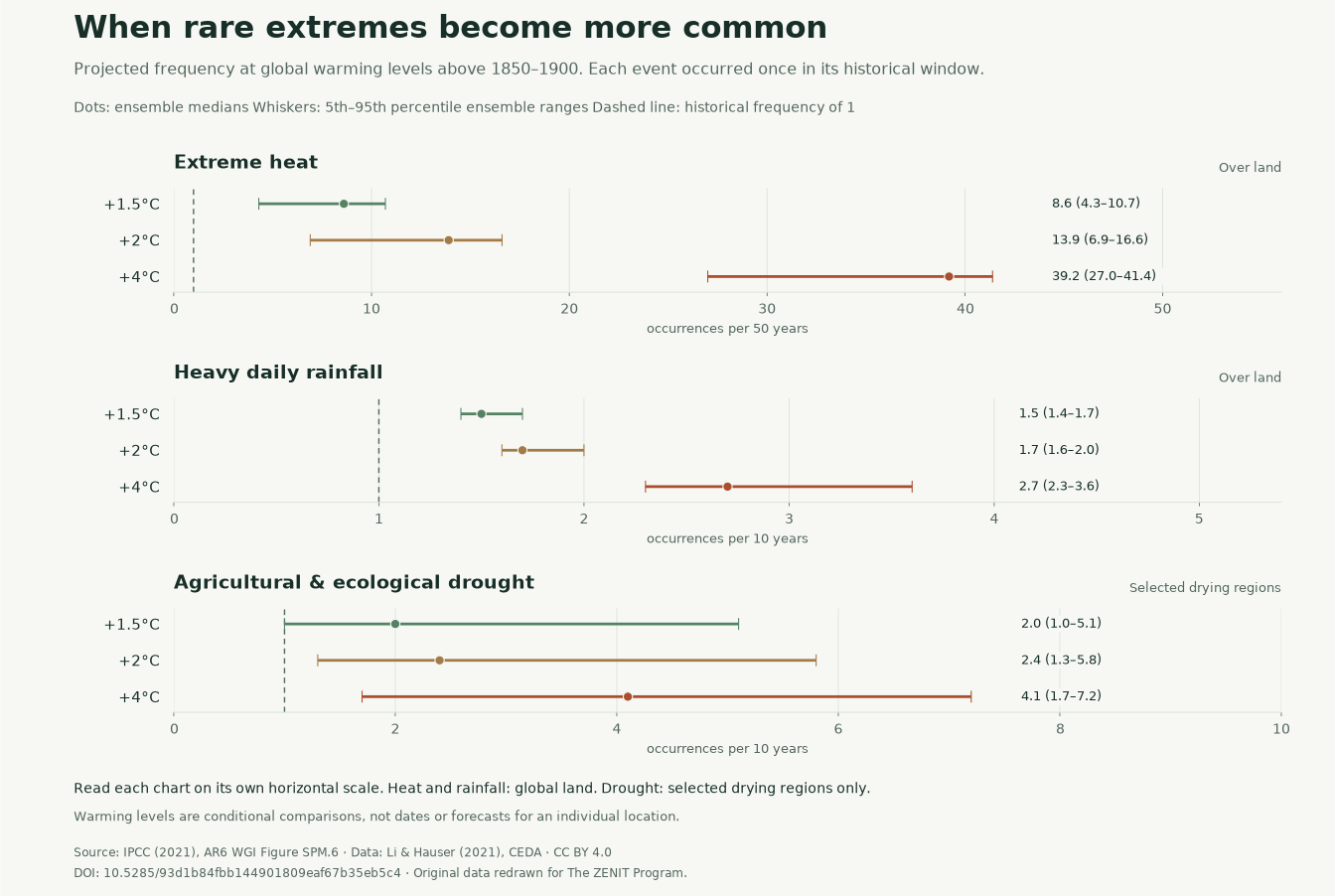
Extreme heat
Over land13.9occurrences per 50 years
050 occurrences
Ensemble range: 6.9–16.6
A changing climate reaches into our homes, our food, our health and our livelihoods. ZENIT Earth proposes a connected response: use energy better, strengthen essential services and develop cleaner mobility. Preparing society—and reducing further warming—is an investment in the life we want to protect.
Delay leaves more at risk. The evidence supports action today, even while future outcomes remain uncertain. Climate science describes a range of possible futures. Society’s choices influence which risks grow, who bears them and how well people can cope. ZENIT’s contribution begins with defined applications: useful heat, understandable infrastructure data and protected essential services.
Warming levels describe a climate state. Scenarios describe possible pathways. Neither specifies the date or cost of a disaster in your town.
Compare published IPCC warming levels. Each event was exceeded, on average, once in the stated period during 1850–1900. C2
At +2°C of global warming above 1850–1900. These are warming levels, without a fixed calendar year.
Ensemble range: 6.9–16.6
Ensemble range: 1.6–2.0
Ensemble range: 1.3–5.8
Large-scale model results; local changes differ. Drought refers to soil moisture in selected drying regions. The ranges describe model-ensemble spread. C2
| Historical rare event | +1.5°C | +2°C | +4°C |
|---|---|---|---|
| Extreme heatoccurrences per 50 years · Over land | 8.64.3–10.7 | 13.96.9–16.6 | 39.227.0–41.4 |
| Heavy daily rainfalloccurrences per 10 years · Over land | 1.51.4–1.7 | 1.71.6–2.0 | 2.72.3–3.6 |
| Agricultural & ecological droughtoccurrences per 10 years · Selected drying regions | 2.01.0–5.1 | 2.41.3–5.8 | 4.11.7–7.2 |
Heat: annual daily maximum temperature. Rainfall: daily precipitation. Drought: annual mean total-column soil moisture below the historical tenth percentile in the selected regions.
Projected global mean sea-level rise by 2100, relative to 1995–2014. These are IPCC likely ranges, with medium confidence. C3
Regional sea level also depends on land movement and ocean conditions. Planning needs a local assessment.
Scenario bounds, rather than a current-policy forecast. Deeply uncertain ice-sheet processes can produce outcomes beyond these ranges.
The IPCC’s 2022 assessment identified this many people living in contexts highly vulnerable to climate change, with high confidence. It is a vulnerability assessment, rather than a forecast of deaths or displacement. C6
Communities need protection that works through its full service life. There is no single complete worldwide price tag for adaptation.
UNEP’s central adaptation-needs estimate. It largely excludes businesses’ own needs; including them could almost double the figure. Developed countries have additional needs. C4
Public adaptation finance flowing from developed to developing countries. Domestic and private spending are outside this measure. C4
Different years and coverage: these figures show the scale of need and support, and cannot be subtracted to calculate a complete global funding gap.
A WRI study of 320 adaptation investments in 12 countries estimated this aggregate benefit over ten years. It includes avoided losses, economic activity and social and environmental benefits. These are projections for assessed investments; project outcomes and investor cash returns differ. C5
We recommend starting with the services people rely on every day, and choosing measures against local risks, full costs and measurable outcomes.
| Priority | Invest in | Measure success |
|---|---|---|
| 01Health & heat | Shade, cooler homes, warnings and safer work routines.ZENIT application: SafeSpots and essential-service planning ↗ | Heat exposure, hospital admissions and access to cooling. |
| 02Water & food | Reliable supplies, water efficiency, soil protection and suitable crops.ZENIT application: Protected energy for water-service equipment ↗ | Water security, reliable yields and household affordability. |
| 03Floods & coasts | Drainage, restored wetlands, appropriate barriers and safer land use.ZENIT application: LSI/NEXUS infrastructure awareness ↗ | People protected, expected losses and maintenance needs. |
| 04Essential networks | Resilient power, transport, communications and backup services.ZENIT application: SERAT priorities, reserves and local protection ↗ | Outage hours, recovery time and access to essential care. |
| 05Fair transitions | Support for exposed households and planned relocation where necessary.ZENIT application: Understandable LSI information for local decisions ↗ | Secure housing, livelihoods and participation in decisions. |
Use local hazard projections and identify who and what is exposed. Include people who have the least ability to pay.
Compare protection, maintenance and relocation over realistic lifetimes. State assumptions and test more than one climate scenario.
Publish outcomes, maintain equipment and revisit the plan as risks change. Reserve room for stronger measures later.
Adaptation has limits. Increasing warming makes some protections less effective and can leave ecosystems and communities facing losses that cannot be fully prevented. Emissions cuts help contain those risks. C6
ZENIT Earth brings energy, sensing, resilient services and mobility research into one programme. Each pathway below connects a climate need to a proposed contribution, a cost basis and a measurable next step.
The stages shown are programme development stages. Benefits are intended outcomes to establish through costed studies, independent review and physical testing. External climate assessments describe the need for action; they do not certify ZENIT systems.
SERAT · Energy & useful heat
The climate need. Useful heat escapes from equipment while nearby buildings or processes still need heating.
ZENIT proposes matching real heat sources with real customers through SERAT: suitable heat exchange, thermal management and protected energy distribution. This can be assessed with existing energy sources while fusion remains a separate research pathway.
Select one site, measure its source and demand temperatures, obtain quotations and compare the candidate against its existing heating system.
LSI + NEXUS + infrared sensing
The climate need. Operators need a clear picture of stressed equipment, thermal hotspots and service disruption.
LSI is the proposed human-readable infrastructure view; NEXUS supports diagnosis and coordination. Infrared sensing adds thermal inspection. A climate-resilience pilot would combine relevant local measurements with authoritative weather and hazard information.
PROGRAMME & TECHNICAL BASIS P1
Choose one facility, define the decisions its operators need to make and test the information and alert chain against known conditions.
Protected energy + SafeSpots
The climate need. A disrupted electricity supply can interrupt cooling, communications, water pumping and other essential services.
ZENIT’s protected-network concept separates important loads, reserves and local protection. SafeSpots provides a research theme for resilient facilities. A proposed community pilot would define a useful service, its backup supply and safe indoor conditions. AXIOM constraints and independent ZSA acceptance remain part of the programme’s safety model.
PROGRAMME & TECHNICAL BASIS P1
Agree the critical loads with a community or facility operator, then cost and independently review a bounded resilience demonstration.
ZENIT hydrogen mobility family
The climate need. Transport needs alternatives that reduce climate impact while meeting real route, payload and safety requirements.
ZC-1 explores hydrogen combustion on the road; ZP-1 addresses passenger transport at sea; ZA-1 and ZA-P01 explore aviation. ZH-1 and ZB-1 are further family concepts. Each vehicle needs its own whole-journey comparison, including hydrogen production and delivery.
Select one representative route and a transparent reference vehicle before making fleet-scale savings claims.
ZENIT Earth Fusion Facility
The climate need. A lower-emission society needs reliable energy alongside efficiency, clean generation and resilient infrastructure.
ZENIT’s facility baseline studies one stellarator-derived core, with a separate SERAT Energy Island. Its 2.00 GWe grid figure is a planning target. The proposed contribution is future electricity and useful-energy integration, subject to successful physics, engineering and safety qualification.
Close the defined engineering and qualification gaps in stages. Communities can pursue the earlier SERAT and resilience studies while this research continues.
ZENIT Academy can support the public-learning side: explaining system choices, trade-offs and results in language communities can use.
Explore the Earth Program ↗See the programme connections ↗Climate statistics retain their original sources. Additional technical references explain the conditions behind the proposed applications; P1 identifies ZENIT’s own programme record.
Conditional policy scenarios and central warming outlooks within this century. Pledges mean Nationally Determined Contributions (NDCs).
Event-frequency medians and 5th–95th percentile CMIP6 ensemble ranges. Data: Li & Hauser (2021), DOI 10.5285/93d1b84fbb144901809eaf67b35eb5c4, CC BY 4.0. Original charts redrawn for this report.
WGI SPM B.5.3 and Synthesis Figure 3.4. Likely global mean rise by 2100 relative to 1995–2014; medium confidence.
Developing-country adaptation needs for 2035 and international public finance flows in 2024. Coverage and timing differ.
320 assessed investments in 12 countries. Projected economic, social and environmental benefits over ten years; outcomes vary.
B.2: human vulnerability assessment, high confidence. Sections C and D: adaptation, limits and climate-resilient development.
Established heat-recovery principles and practical limits. This reference does not establish SERAT performance.
Hydrogen production, electricity supply and delivery affect lifecycle emissions.
Hydrogen combustion can produce nitrogen oxides; emissions depend on combustion and control conditions.
Aviation climate assessment includes non-CO2 effects; hydrogen combustion still requires NOx and water-vapour assessment.
Sector-wide materials, fuel-cycle and plant-engineering development needs. No assessment or endorsement of ZENIT is implied.
ZENIT-owned concept and planning records for SERAT, LSI/NEXUS, sensing, protected networks, SafeSpots, mobility and fusion. Programme descriptions do not establish physical performance.
Chart data attribution: Li, C.; Hauser, M. (2021), data for IPCC AR6 WGI Figure SPM.6, NERC EDS CEDA, DOI 10.5285/93d1b84fbb144901809eaf67b35eb5c4, CC BY 4.0. IPCC (2021), Climate Change 2021: The Physical Science Basis, Summary for Policymakers, Figure SPM.6. Charts are newly drawn.
The future deserves
our preparation.